
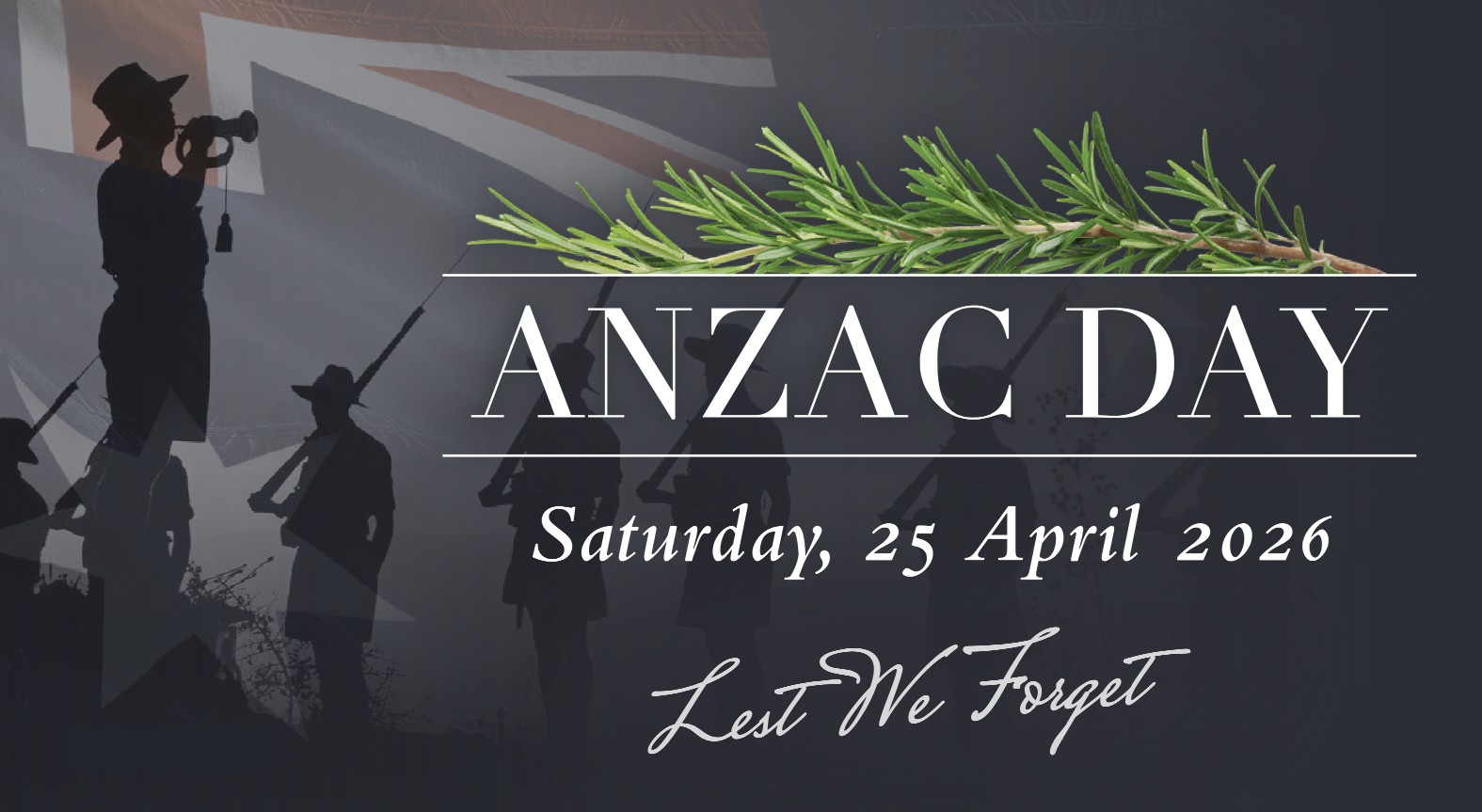


Anzac Day Address
Dawn Service
Mount Gambier War Memorial - Vansittart Park
Saturday, 25 April 2026
Good Morning
I must confess to experiencing some nerves, I have been coming to this Dawn Service for more than 25 years but, as someone who has never worn our nation’s uniform, I never envisaged being asked to give the Anzac address.
That being said and with the approval of his family, to whom I offer my deepest condolences, I want to dedicate this address to someone who did, Peter Bruhn was a fine man, he was a friend and a true custodian of the ANZAC spirit. For me it is almost unfathomable to envisage an Anzac Day without his beaming smile, his infectious laugh and his sense of larrikinism.
We gather together this morning in the cold and the dark before dawn to honor those soldiers, sailors, airmen, nurses and citizens otherwise who served our nation.
It is now 111 years since our first Anzacs splashed onto the beach at Gallipoli.
They left a young Nation, federated just 14 years earlier. We had a parliament and a flag but no real sense of nationhood because our story up until then was of the 6 formative British colonies.
In the words of the official war historian Charles Bean:
“When our soldiers sailed for war, they left a nation that did not yet know itself.”
For those that lived through it, the great war blotted out everything that had come before.
From an Australian population of just under five million, 417,000 enlisted, 332,000 served overseas, 152,000 were wounded and tragically 61,000 never came home.
Of the men aged 18-42 almost 1 in 2 served in uniform and of those who served overseas almost 1 in 5 were killed in action.
Of the 270,000 who returned home more than half were wounded and it is impossible to imagine how many were psychologically scarred.
Individually and collectively, it was a sacrifice on a stupendous scale.
None of that generation now survive, but all Australians have been imbibed with what matters most, that a generation of young Australians rallied to serve their country when their country called and they were faithful to it even unto death.
The first ANZACS were tradesman, clerk’s, laborers, farmers and professionals. They were from every conceivable occupation, from every rung in the ladder of society and from every point under the Southern Cross.
In volunteering to serve they were transformed into much more than soldiers they became the founding heroes of modern Australia.
If they had not been emblematic of a nation we thought we were, ANZAC DAY would not have been commemorated from that time until this – in every part of our country, in every place were Australians gather and in every military base where Australians serve.
If they were not still emblematic of the nation we think we are, none of us would be here this morning.
But like every generation since, we are here because we believe the original ANZACS represent Australia at its best.
It’s the perseverance of those that scaled the cliffs under a rain of fire;
It’s the compassion of the nurses who tended to the thousands of wounded;
It’s the conquest of fear, often through a larrikin sense of humour; and
It’s the greatest love anyone can have: the readiness to lay down your life for a friend.
It was these qualities that ennobled those Anzacs to all who have come after them: they faced the hardest possible test and they did not flinch.
Whilst the campaign at Gallipoli was ultimately a failure, the survivors of Gallipoli and their reinforcements went on to become some of the world’s finest soldiers.
The Australian and New Zealand mounted infantry spearheaded the British army that captured Jerusalem and Damascus and the charge of the Australian Light Horse at Beersheba remains military legend.
In 1918 it was the Australian Army corps that held the last great German attack that had split the British from the French armies and it was Monash, the engineering genius and citizen soldier, the commander who’d struggled at Gallipoli but succeeded in France, who pioneered the all arms warfare that led to victory by breaking the bloody stale mate on the western front.
Over more than a century the ANZAC decedents have honored that tradition in the second World War, in Korea, in Malaya, in Borneo, in Vietnam, in Iraq and of course during our longest war, in Afghanistan.
Those serving on peacekeeping and relief missions have likewise kept faith with the original ANZACS. Even now our armed forces are serving in the middle east and elsewhere defending the values that we hold dear.
Happily, the history of ANZAC is taught in our schools and it is great to see so many young people with us this morning, what is perhaps lesser known but equally important is how fragile our freedom actually is and how close we came to losing it.
Too few of us know that at the end of 1941 when Japan, now a friend but then the evilest of enemies, was invading, conquering and pillaging all lands in the region.
On the morning of February 19, 1942, 242 Japanese planes dropped 681 bombs on the city of Darwin. Our nation had come under attack at a time when Australians believed that concept to have been impossible. We were no longer safe.
The attacks continued 111 more times over the next 2 years, military bases and installations were attacked by air and by sea at Townsville, Broome, Sydney, Derby, Katherine, Wyndham, Port Headland and Exmouth along with another 60 attacks on Darwin itself. These devastating attacks took hundreds of Australian lives and injured thousands more. The battlefield was no longer half a world away; our country had become the front line.
Prime Minister John Curtain explained the attacks on Australia when he said: -
“That a severe blow had been struck on the Australian soil”
Against the orders of Prime Minister Winston Churchill our divisions in the middle east including the Rats of Tobruk were rushed home. These heroes along with the heroes conscripted into the militia were rushed into New Guinea to halt the Japanese charge to Australia along the Kokoda track.
As hard as it is for us to conceive of this notion today, Australia was under siege. Like the war-torn places of the modern world that are broadcast into our living rooms, war had come to Australia and we were forced to fight to protect our land and our homes.
We should never under any circumstances take the safety we feel today for granted. In the emergency of 1941 and 1942 this safety was taken away from us. It was won back with courage and sacrifice.
In our minute silence today take the opportunity to imagine the fear, chaos, and loss we would experience today if this were to reoccur. It is not difficult to imagine but it is difficult, as it was then, to believe that it could happen here. Use the minutes silence to remember and thank those who secured this safety for us then and those who preserve it today.
Most of us have never worn our nation’s uniform, none of us climbed the steep cliffs at Gallipoli, none of us trudged through the snow at Bullecourt or struggled through the mud at Passchendaele. None of us have experienced the horrors of Hell Fire Pass or fought in Kokoda. Very few of us have camped in the jungles of Vietnam or shaken the Uruzgan sand from our clothes. We have not risked being shot out of the skies over Germany or torpedoed in the Mediterranean or in the pacific, but we are better for those who have because they rose to their challenges we believe it is a little easier for us to rise to ours. Their example we believe helps us to be better than we otherwise would be. That’s why we are here, to acknowledge what they have done for us and what they still do for us.
Charles Bean said of the original Anzacs
“Their story rises as it will also rise above the mist of ages a monument to great hearted men and for their nation a possession forever.”
Yes, Bean was right - they are us and when we strive enough for the right things we can be more like them.
So much has changed in 111 years but not the things that really matter, duty, selflessness, moral courage, these remain the mark of a decent human being.
They did their duty; now, let us do ours,
They gave us an example; now, let us be worthy of it.
They were as good as they could be in their time; now, let us be as good as we can be in ours.
Lest We Forget.
 Click Here to watch the ANZAC Day Address.
Latest
October 15, 2026
Liberal and Nationals unveil taskforce to restore regional water security
September 10, 2026
Rural and Regional Liberals Demand Action on Working Holiday Visa Delays
September 10, 2026